

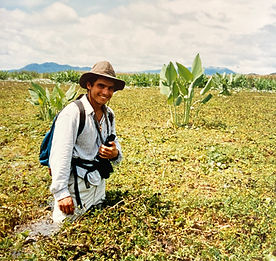
GreenLatinos Summit, 2016, Grand Teton National Park




.jpg)


COMMUNITY and FELLOWSHIP
There are numerous communities within environmental conservation. I've had the pleasure to experience a few; the science and academic community, those focused on protected areas and national parks, communities connected to the protection of fauna and flora, and of course there are very strong communities around culture and and ethnicity. I recognize the great influence my heritage in the Latino community has had - and how it helped shape my connection to nature.
As a Mexican-American Latino with roots grounded in the Rio Grande Valley of Texas (Tejano), I spent much of my childhood outside. Little did I know I was in subtropical savanna and chaparral habitat. Nor did I realize the nearby wildlife refuge has the highest number of nesting birds than any other refuge in the US. And Brownsville also had the Gladys Porter Zoo. For a young biologist, this environment made its mark. Soft-shelled river turtles, green jays, sunfish, opossums, Texas horned lizards, and crested caracaras - were all regulars. The wetland inlets of Boca Chica beach where my friends and I would shuffle our feet so as not to get hit by a stingray is now ground zero for Starbase (SpaceX). The views of that never-ending horizon from the refuge border are now lined with wind turbines. And the first thing that comes to mind is that the kids growing up in the Valley today are experiencing something entirely different. But whose to say that a child today seeing a common nighthawk suddenly drop 500 feet to catch an insect will not be as transformed. And knowing the ocelot population is doing better these days gives me hope.
I do my best to inspire and encourage young minorities to recognize education as a path toward an improved, more rewarding life. As a first generation college student, I recognize the ripple effect a strong education can have for you (your future) and your family. With this lived experience, I continue to work as an advisor, mentor, and role model for all students of all ages. I strongly believe in mentoring. It is important for students to have access to an effective mentor - and it is our responsibility to reach out and help our younger professionals network, understand strategy, and build confidence.
I feel compelled to recognize the substantive role the Smithsonian Latino Center played in my professional career. When I first entered Smithsonian, it was under a Latino grant that allowed me to work at the National Zoological Park’s Amazonia Exhibit. Eventually that role would evolve into a 7-year stretch of geospatial science management throughout the 8-country region of Amazonia.
Further in my career, a Smithsonian Latino grant also enabled me to come full circle – and take a small group of Latino students from GMU to conduct field work with me in Kenya. Each student has since continued toward their own exciting career opportunities and are carrying the torch for many other future Latino conservation scientists.
I would like to recognize GreenLatinos as an incredible source of inspiration in my most recent work with NPCA - by bringing Latinos together and working hard to protect the environment.
Helpful links:
Advice for Latinx in conservation.
Occupational Outlook Handbook: The Occupational Outlook Handbook (OOH) is a publication of the United States Department of Labor's Bureau of Labor Statistics that includes information about the nature of work, working conditions, training and education, earnings and job outlook for hundreds of different occupations in the United States.
If you want to try and match the cost of your university degree (your loan debt) and how much the jobs with that degree will likely earn - this resource can help you make that determination.